Case Study: How I Made Mezo's Documentation Agent-Ready
by Abdulganiy Adeleke, published on Nov 16, 2026
On this page
 BeforeAfter
Mezo is a blockchain network that enables developers to build decentralized applications for the Bitcoin community.
As a member of the Mezo community, I noticed they were preparing to host a hackathon, the Mezo Buildathon. The event ran in two waves, each lasting about two weeks, from October 16 to November 15, 2026.
Recently, I have focused on agent-ready documentation. I saw the Buildathon as an opportunity to put my learning into practice.
The Problem
Coding agents now read documentation on behalf of developers. They rely on it to understand products and complete development tasks, and they are becoming its primary consumers. Fern published a report on November 10, 2026 that found 52% of documentation traffic comes from agents, up from 14% in January.
Developer experience now depends on how well agents navigate documentation.
AI agents read documentation differently from people. They need an index file (llms.txt) that tells them where each page lives, and a clean Markdown version of each page.
Mezo's documentation lacked the structure agents need to navigate and consume its content.
When agents cannot navigate documentation, they miss information or give wrong answers. Developers who rely on those answers lose trust, and the developer experience suffers.
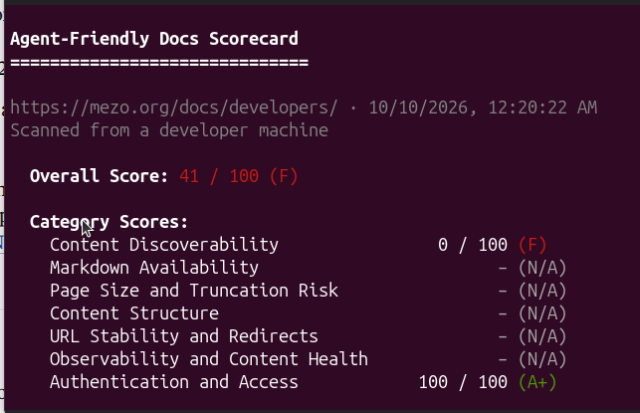
On October 10, 2026, I assessed Mezo's documentation using AFDocs. AFDocs is a specification for evaluating how well documentation supports AI agents. Mezo's documentation scored 41 out of 100, an F.
Only two of seven categories could be scored.
- Authentication and access (100/100).
- Content discoverability (0/100).
Authentication and access scored 100 because the documentation already supported standard HTTP behavior. Content discoverability scored 0 because there was no agent-facing content. The check marked the following five categories as Not Applicable (N/A) for the same reason.
- Markdown availability.
- Page size and truncation risk.
- Content structure.
- URL stability and redirects.
- Observability and content health.
Solution
I opened an issue for each problem and fixed them in eight pull requests.
My first change was to the internal documentation, a README for the repository owner. The file listed many pages that did not exist. I fixed the links so every listed page opens (PR #345).
The second change kept the README out of the files agents read, such as llms.txt and the Markdown pages (PR #352).
One PR (PR #349) covers Markdown availability, structure, size, and URL stability. The four checks examine whether the Markdown files exist and whether their properties are correct.
The other PRs ensure that agents can discover and consume those files. The build automatically regenerates everything I created whenever the site changes, so nothing has to be updated by hand.
Markdown availability
Markdown is easier for AI agents to read than HTML pages. I wrote a script that creates a Markdown version of each live documentation page (PR #349).
Content structure
The same script keeps headings and code blocks intact on every Markdown page. Usually, React components in MDX source become visual elements when the documentation is built.
Since the agent-facing Markdown depends on the same MDX source, the script strips the component syntax and turns its content into plain text. This prevents agents from receiving the raw components as code.
I also made tabbed content write out one tab after another, each with its label. This ensures one tab's content is never mistaken for another's (PR #349).
The script also wrote links to other pages as short paths, such as /docs/users/borrow.
Those links only work while the reader is on mezo.org. Once you copy the Markdown locally, the path points to the wrong place. I changed the script to write every link as a full web address and fixed nine links that led to missing pages (404).
The link check markdown-link-portability, which failed before, now passes (PR #362).
Page size
I kept each Markdown page under 50,000 characters without cutting its content. This ensures an agent never has to open two pages to get one piece of information (PR #349).
URL stability and redirects
This category checks that web addresses respond correctly. That includes a correct error response for bad addresses and a working redirect. Creating the Markdown pages gave agents working links to follow, so that work also covered this category (PR #349).
Content discoverability
Agents cannot use Markdown pages they do not know exist.
- I generated
llms.txt, an index agents can follow, andllms-full.txt, the full text of every page. Each entry links to a page's Markdown version (PR #354). - I added descriptions to 8 pages that had none. Agents use the descriptions to understand what each page covers, and the descriptions feed the
llms.txtentries (PR #347). - I added a directive to the HTML pages (PR #357). A directive is a short instruction in the HTML source that points agents to
llms.txt. I later noticed it was missing from the Markdown pages, so I added it there too (PR #360).
Observability and content health
I created a script that generates llms.txt from the same Markdown files, so the index and the pages remain in sync (PR #354).
Outcome
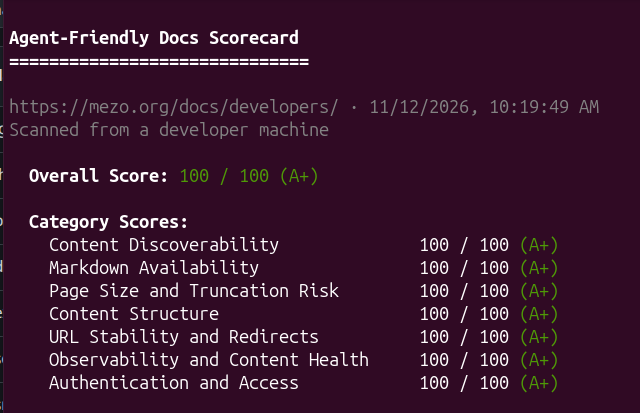
After the fixes, the score went from 41/100 (F) to 100/100 (A+). Every category now scores 100.
| Category | Before | After |
|---|---|---|
| Overall | 41 (F) | 100 (A+) |
| Markdown availability | N/A | 100 |
| Page size and truncation risk | N/A | 100 |
| Content structure | N/A | 100 |
| URL stability and redirects | N/A | 100 |
| Content discoverability | 0 | 100 |
| Observability and content health | N/A | 100 |
| Authentication and access | 100 | 100 |
N/A means the check had nothing to test.
Agents now get the Markdown version and the llms.txt map they need.
Verify it yourself
You need Node.js to run this command. It queries Mezo's live docs and prints the current AFDocs scorecard.
npx afdocs check https://mezo.org/docs/developers --format scorecardThe output is a scorecard like the screenshots above, with one line for each category and an overall score.
Note. My runs were on October 10, 2026 and November 12, 2026. Mezo's docs may have changed since.
What I learned
This work taught me one important lesson about directive placement.
Place the llms.txt directive in both the HTML pages and the individual .md files.
I initially followed the implementation used in the Claude Code documentation. It hides the llms.txt directive in the HTML source, as shown below.
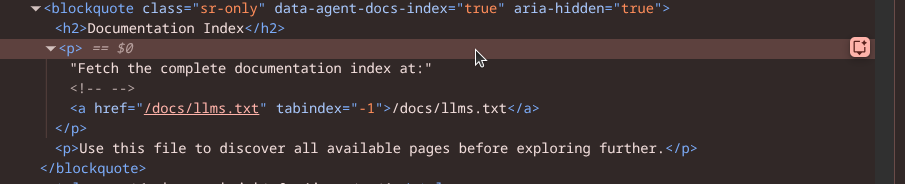
I also updated my Markdown conversion script to add the directive at the top of each .md file, so agents could see it without visual noise or screen readers reading it aloud.
The reviewer raised a concern about mozilla/readability, a library that extracts the main text from a page. He said this extraction method, which agents can use, removes hidden content. He also mentioned that the official Model Context Protocol (MCP) server uses this mode by default.
Acting on that concern, he briefly removed the directive from the HTML pages and added a link to llms.txt in the footer instead. I wanted to know how that decision affected llms.txt discoverability.
I then checked with OpenCode, which uses content negotiation to request Markdown instead of HTML, and the Markdown it received did not contain the directive.
The agent negotiated for Markdown instead of HTML, and the server generated the Markdown from HTML. When it followed a .md link from llms.txt, it got the version I pre-generated.
That meant an agent that negotiated for Markdown this way never saw the directive, so it never found llms.txt.
Claude Code and Cursor use the same content negotiation, so they would also be affected. Agents cannot locate the .md files on their own. They find them only after they discover llms.txt, so the directive needed to be in both places.
I also tested the reviewer's mozilla/readability concern. Agents using an MCP server could still see the directive even when it was visually hidden. That kept llms.txt discoverable, so we added the directive back to the HTML pages.
Want results like this?
I write developer documentation that serves both human developers and AI agents.
Let's talk about your docs.